





Seoul, 1978. At South Korea’s top university, the nation’s best and brightest compete to join the professional elite of an authoritarian regime. Success could lead to a life of rarefied privilege and wealth; failure means being left irrevocably behind.For childhood friends Jisun and Namin, the stakes couldn’t be more different. Jisun, the daughter of a powerful business mogul, grew up on a mountainside estate with lush gardens and a dedicated chauffeur. Namin’s parents run a tented food cart from dawn to curfew; her sister works in a shoe factory. Now Jisun wants as little to do with her father’s world as possible, abandoning her schoolwork in favor of the underground activist movement, while Namin studies tirelessly in the service of one goal: to launch herself and her family out of poverty.But everything changes when Jisun and Namin meet an ambitious, charming student named Sunam, whose need to please his family has led him to a prestigious club: the Circle. Under the influence of his mentor, Juno, a manipulative social climber, Sunam becomes entangled with both women, as they all make choices that will change their lives forever.In this sweeping yet intimate debut, Yoojin Grace Wuertz details four intertwining lives that are rife with turmoil and desire, private anxieties and public betrayals, dashed hopes and broken dreams—while a nation moves toward prosperity at any cost.
Praise
“Wuertz has written a rich and descriptive case study — or a “Gatsby”-esque takedown, if you will — of 1970s South Korea. Reading “Everything Belongs to Us” is as much an education in sociology and history as it is a story about people, and the characters are so memorable they lend an intimacy to that history.” — The New York Times Book Review
“An ambitious debut about power and family in South Korea with rich character portraits and a strong political heartbeat. Wuertz’s book blooms in unexpected ways, eschewing a straightforward plot for more meandering paths. While the framework of the novel isn’t always tidy, the book is no less a significant representation of the politics of postwar hope and despair. Engrossing…Wuertz is an important new voice in American fiction.”—KIRKUS (starred review)
“An absorbing debut destined for major lists and nominations.”—Booklist
“If South Korea transformed in a generation, this is the generation that transformed it: rich and poor, reckless and disciplined, loyal and faithless. Yoojin Grace Wuertz’s fierce and unforgettable characters embody every contradiction as they do everything they can to ensure their own, and their nation’s, survival. In Everything Belongs to Us, Wuertz has given us a Middlemarch for modern South Korea. She’s woven the whole social tapestry, and made us care about every last thread.”—Susan Choi, author of My Education
“I found myself engrossed in the difficult choices faced by Wuertz’s nuanced, engaging characters as they navigate college politics and romance in 1970s Seoul. I’m thrilled to have experienced their inner lives in these pages—to have celebrated their victories and commiserated in the pain of their mistakes—and would happily have stuck with them for hundreds more.”—Emily Barton, author of The Book of Esther
“What a story! Everything belongs to this terrific debut: love, family, friendship, and politics. I especially loved the two strong-willed and passionate heroines. Their ideals, choices, and struggles make this an utterly rapturous literary page-turner.”—Samuel Park, author of This Burns My Heart
“Historic in scope yet eerily contemporary, Everything Belongs to Us is a stirring debut that immerses readers in a society where some quietly hope for change and others must demand it. In Yoojin Grace Wuertz’s capable hands, characters come alive with desire for a different kind of life, and heartbreak is the price of longing.”—Jung Yun, author of Shelter
“Less a debut and more an arrival, this arresting first novel from Yoojin Grace Wuertz brings to life a South Korea poised on the brink of transformation and the young people caught up in its turbulence.” Shelf Awareness
“The finest historical fictions read, forever, as relevant. And due to Yoojin Grace Wuertz’s skill and the current American presidency, the author’s debut novel proves hauntingly relevant.” Paste Magazine
Reviews
An ambitious debut about power and family in South Korea with rich character portraits and a strong political heartbeat.
In her first novel, Wuertz traces the ambitions of four loosely connected students attending Seoul National University in 1978. There’s Jisun, a revolutionary at heart fighting for autonomy from her wealthy and influential father; Namin, a poor scholarship student struggling to bury her family’s past and lift them out of poverty; Sunam, a striver caught between the different futures these young women offer him; and Juno, an ingratiating social climber only interested in his own advancement. It’s no accident that the book opens—and closes—amid the clamor of protest, from striking textile workers roughed into police vans to a smoke bomb planted during a college graduation ceremony. Wuertz investigates a national crisis surrounding worker exploitation and upward mobility, the complicity of the rich, and the stifling indecision of the middle class. With deep sympathy and psychological insight, she demonstrates how a corrupt political regime bankrupts—literally and figuratively—the choices of her characters, pushing them to moral extremes. Namin is forced to choose between caretaking for her beloved disabled brother and raising her sister’s illegitimate son, while Sunam struggles with a bribe of unimaginable magnitude. Even spirited Jisun must negotiate for her freedom. To outsmart her controlling father, she chooses to give away her fortune to the legal funds of protesters. At the bank, she’s left with “an eerie feeling like stealing from a ghost, a fictional character with her name and identification number.” Jisun isn’t the only ghost walking in the pages of this book, which collects and mourns the forgotten, downtrodden souls these four must rescue or leap over in their race to the top. Wuertz’s book blooms in unexpected ways, eschewing a straightforward plot for more meandering paths. While the framework of the novel isn’t always tidy, the book is no less a significant representation of the politics of postwar hope and despair.
Engrossing. Wuertz is an important new voice in American fiction.
As explosive growth transforms 1970s South Korea into an international powerhouse, sociopolitical upheaval becomes unavoidable in daily life. Into the maelstrom of such spectacular change, first-novelist Yoojin Grace Wuertz – Seoul-born, U.S.-raised, Yale- and NYU-degreed – drops two women onto the elite campus of Seoul National University.
Jisun is there by birthright as the daughter of a wealthy, powerful businessman, but she eschews her privilege to live with factory workers, join demonstrations, get arrested, and aid underground organizations. In contrast, Namin has outperformed everyone to gain entry; her singular goal of becoming a medical doctor equals her family’s escape from poverty. The girls’ childhood best-friendship falters as each twentysomething faces complex crises against the backdrop of a nation-in-the-remaking.
Wuertz assuredly bears witness to the tumult of her birth country: clashes with U.S. occupiers, the widening divide between haves and have-nots, the dismantling of traditional family structures, the impending end of a dictatorship, and the possibilities of a future when everything might belong to a generation not fully prepared for the challenges to come. An absorbing debut destined for major lists and nominations.
Wuertz’s memorable debut takes place in 1978 Seoul and follows four university students—two boys, two girls—as they work and fumble their way through a school year of camaraderie and betrayal. The girls—Namin, a serious student seen as her poor family’s one hope at financial success, and Jisun, her wealthy childhood pal bent on becoming a labor activist—find their friendship in flux as they begin drifting down separate paths toward adulthood. Their story lines bring them in contact with Sunam, a charming student struggling to find his spot on the social ladder, and Juno, a more experienced boy sponsoring Sunam as a pledge to the university social club, the Circle. Juno desires Jisun, who eschews his interest, and Sunam and Namin become a romantic item after meeting at a party held by the Circle. But it isn’t long before Namin’s studies and family life—an American GI impregnates her older sister—pulls her away from Sunam’s affection, and he begins spending more time with the seductive Jisun. Wuertz crafts a story with delicious scenes and plot threads, perceptively showing the push and pull of relationships in a strictly mannered society. (Feb.)
For Readers
 The author's mother in 1975 at Ewha Woman's University, where she was a third year student.


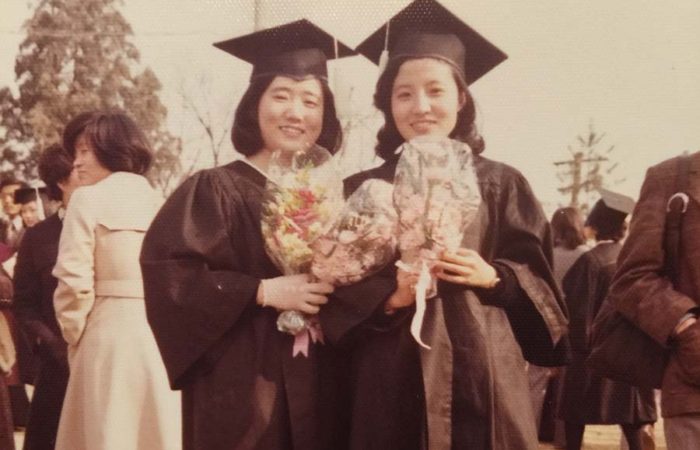


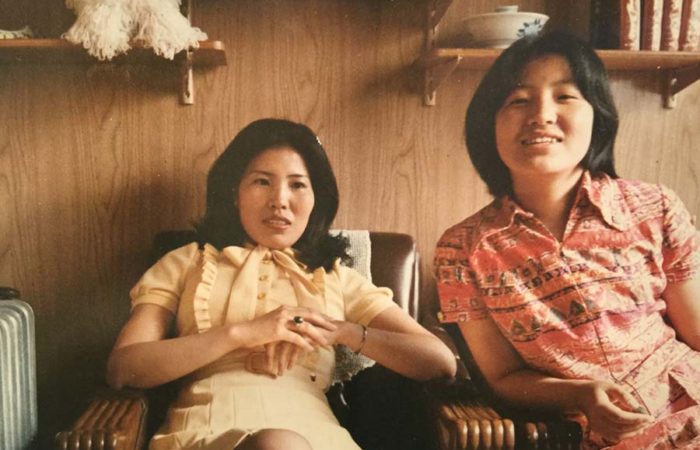


EVERYTHING BELONGS TO US is a work of fiction inspired by stories Grace heard from her parents about their college years. Grace’s parents met as freshmen while her father was at Seoul National University and her mother was at Ewha Woman’s University. Her father’s memories of the political climate during these years sparked Grace’s initial ideas for the novel, but neither of her parents were student activists. Grace’s mother, like Namin, grew up in Miari and was the first student in her working class town to test into the prestigious Kyungki Middle School, where she met her lifelong best friend. Living in Seoul and New Jersey, they are still best friends to this day. Grace’s mother was put through college by her older sister, who worked for a company selling pianos. Grace’s aunt raised two children and is a talented florist in Leonia, New Jersey.
FOR BOOK CLUBS
Discussion Questions:
- The title, “Everything Belongs to Us,” is a play off a statement that the police officer says to Jisun after she is arrested. He says “Not everything belongs to you.” The characters in the book are college students living in a time of great change, and in many ways they are living with this manifesto in mind. Everything could potentially belong to them, but at a price. What is the price? Is it worth it? How is the title both accurate and ironic to their lives?
- The two women in the book are childhood friends, but their relationship has always been complicated and made tense by their class differences. How do poverty and wealth affect the choices each woman makes? How do poverty and wealth affect the emotional dynamics of their relationship?
- Related: how does poverty and wealth contribute to each character’s sense of shame and pride? Namin, for instance, feels ashamed of her poverty but this sometimes manifests as pride. On the other hand, Jisun is ashamed of her privilege because it separates her from the other activists—and Namin—whose community and approval she craves.
- Although this book is set forty years ago on the opposite side of the world from the U.S., how are the themes of social, political and economic justice relevant to our current U.S. events? How are they different?
- How is youth both a benefit and liability to the characters in the book? Their youthful energy and ambition put them in positions where they have much to gain during this pivotal time in the nation’s history. On the other hand, their youthful indiscretions and inexperience drive the decisions they make, and their outcomes. How do you think these major decisions might have changed if they had been 35 or 25 instead of 19? How might things have turned out differently?
- Korean culture is traditionally very communal (ie. focused more on the group rather than the individual). How do family roles, interventions, and dynamics affect individual outcomes for Jisun, Namin and Sunam? And thinking of larger groups beyond the family: how do the actions of powerful corporations (for example, Ahn) and authoritarian government (President Park Chung-hee) affect the individuals during this time period?